
How to See Your Network as an Ecosystem
The noise level is higher than it has ever been.
More content, more platforms, more people competing for attention at the same time.
In that environment, the solution seems obvious: If you want your work to spread, be louder. Post more. Say it faster. Learn how to break through.
There is a version of this that works.
With enough money, enough reach, and a willingness to apply sustained pressure, attention can be engineered for short stretches of time. This approach depends on constant escalation; the moment the pressure eases, the effect drops off.
Most people doing Great Work are not here for that.
They are not dedicating years of their lives to an idea so it can only survive under constant strain. They're building something that can deepen over time when it's a good fit.
That difference matters.
Why surface models fail for Great Work
People are rarely confused about what they are “supposed” to do. The instructions are everywhere. Reach out. Promote harder. Create urgency. Chase attention.
The resistance, however, shows up immediately.
The resistance we feel isn’t limited to false urgency or manufactured scarcity. It is a resistance to the entire orientation toward the surface. The antics. The sense that visibility requires constant performance rather than accumulated understanding.
For people committed to meaningful, trust-based work, this feels like being asked to trade depth for display.
And many of us have opted out of that model. And when we try to override it, our body confirms the mismatch. A tightening. A sense of overstepping. A feeling that an important line is being crossed.
We sometimes misread our own hesitation as procrastination or a mindset problem. It isn’t.
This refusal is not about effort. We are hard workers by nature.
It is about fit.
Surface models assume that outcomes improve when activity increases. More posts. More outreach. More exposure. These methods work best in environments where attention can be treated as something to capture and convert.
Most Great Work does not behave that way.
Great Work asks people to understand it well enough to explain it to others, which cannot be rushed. It takes time. Repetition. Deepening.
How psychology gives us another way
Psychology offers a different way to understand how ideas, opportunities, and recognition move. Instead of starting with tactics, it starts by observing what happens when ideas are strong enough to matter.
Psychological research gives us insight into two important questions.
What primes a powerful idea for movement?
When an idea changes how people think, it rarely spreads because it was promoted well. It spreads because it is coherent enough to be recognized and understood. People tend to need to encounter it more than once, and it needs to be clear where to go if they want to understand it more deeply.
This pattern shows up across scientific revolutions, intellectual movements, and paradigm shifts. Ideas that matter move through clarity, repetition, and continuity. They give people time to understand them.
Powerful work travels this way because it lives inside meaning, not momentum.
People carry it forward (and the work spreads) when they understand it well enough to explain it to the people they know. That requires repetition. It requires clear opportunities to go deeper. It requires a stable emotional center.
Once an idea is structured in this way, a second question follows:
What does movement for an idea like this one look like?
Social network theory offers a concrete answer to this second question. It looks at how ideas, opportunities, and recognition move through groups of people over time.
Not every connection operates the same way. In fact, there are three kinds of connection, and they participate very differently in moving your work through the world.
Strong ties are your friends, family, collaborators, and close colleagues. They know your work well. They support you consistently. You need them, and you are likely very grateful for the steadiness they provide.
What strong ties do not usually provide is reach, because they move in the same circles you do. They tend to know the same people, hear the same conversations, and have access to the same opportunities. Their value is depth and stability, not fresh perspectives or unseen opportunities.
Weak ties are acquaintances, former colleagues, and people you have crossed paths with but do not know well. They do not know your work deeply. They are not invested in your day-to-day progress. They may not even remember your name the first time they are asked!
What weak ties provide is access.
They move through different circles than you do. They encounter conversations, opportunities, and contexts that may otherwise never reach your life.
And then there is the often misunderstood middle tier.
Moderate ties live in what I think of as the magical middle. They know your name. They have a working understanding of your Great Work. And for our purposes, they like it. Critically, they are familiar enough to explain your work accurately and distant enough to extend its reach.
What moderate ties provide is movement.
They move through adjacent worlds that are close enough to understand your work and different enough to carry it forward. Because they are already oriented, they can recognize when your work fits an opportunity that appears, often before you ever see it.
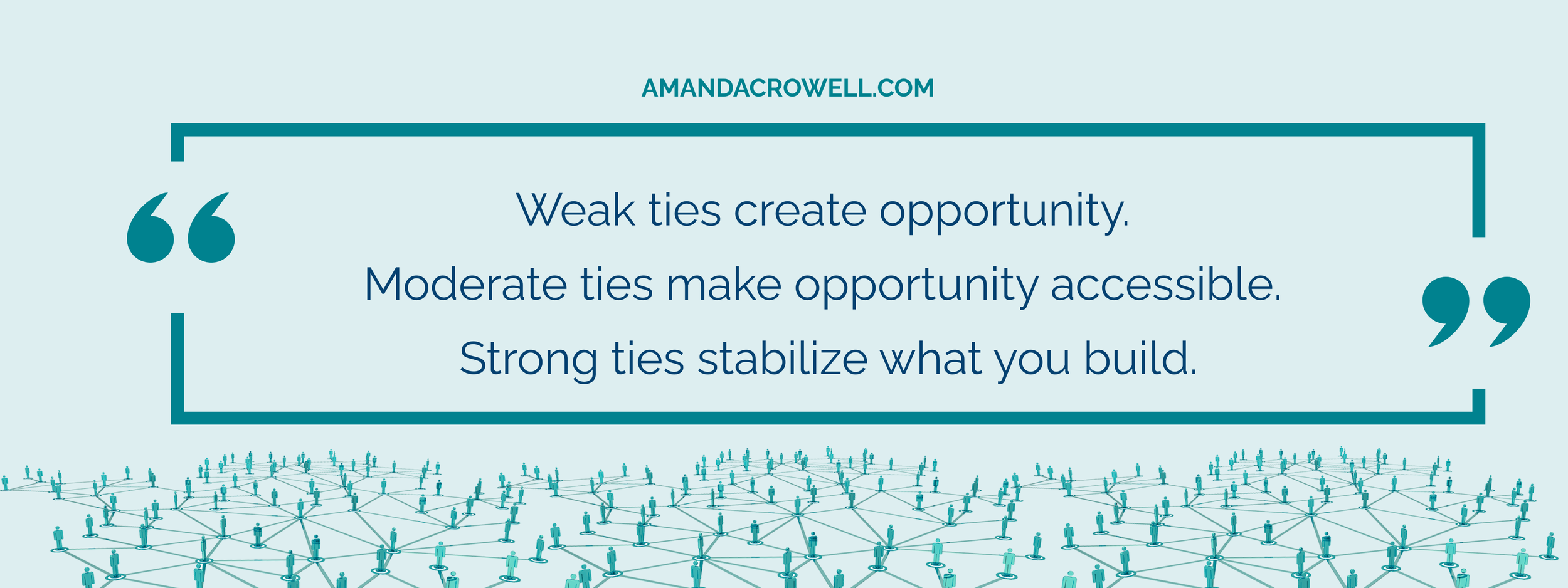
This middle is also where relationships change. Some weak ties deepen into moderate ties. And a few lucky moderate ties deepen into strong ties over time. Familiarity turns into trust. Recognition turns into collaboration.
This points to an important insight: Your network is not static. It is always in motion.
Seeing your network as an ecosystem
Once you understand how different kinds of connections function, the frame shifts.
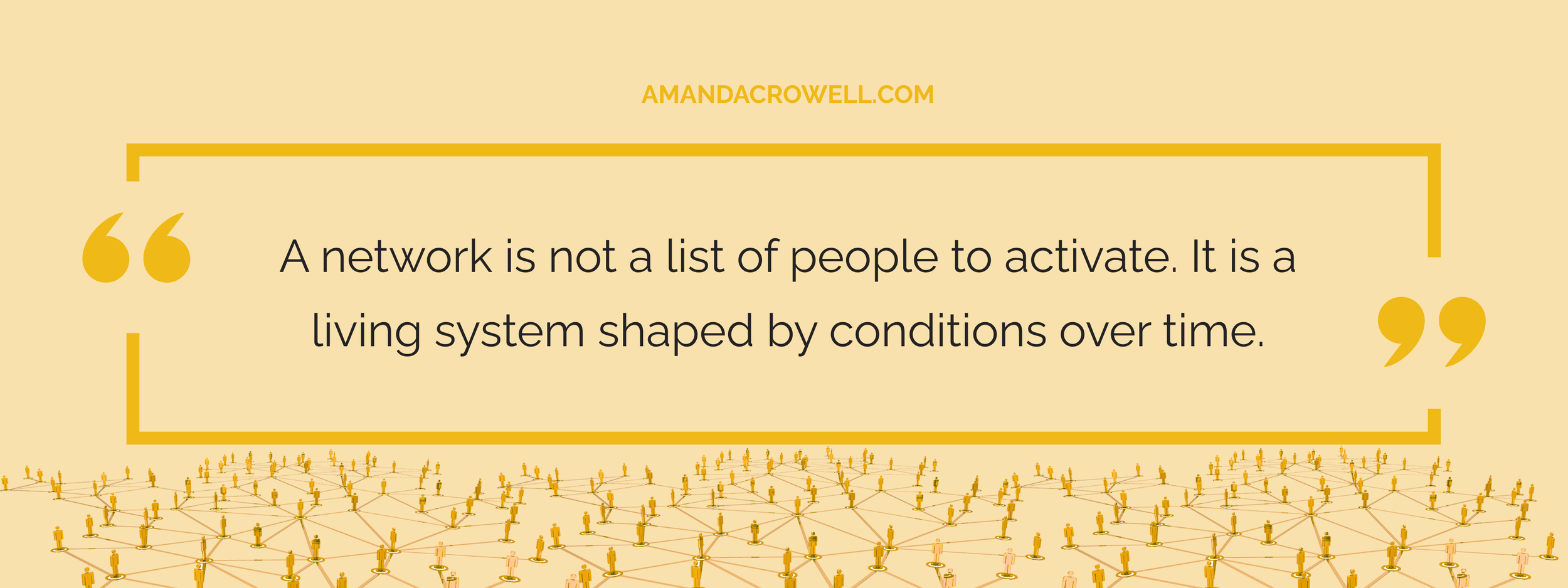
A network stops looking like a list of people you should be doing something with. It starts to look like a living system shaped by conditions over time.
An ecosystem is not held together by control. It stays healthy because the environment supports circulation, recognition, and change. Different parts play different roles. Movement happens without constant intervention.
Seen this way, your role changes.
You are no longer responsible for activating every connection or extracting outcomes from each interaction. You are responsible for maintaining conditions where understanding can accumulate and where people can orient themselves to your work over time.
In a living ecosystem, ties are not fixed. Weak ties warm. Moderate ties deepen. Some relationships grow into strong ones. Others drift away.
That movement is not a problem to solve. It is how systems stay adaptive.
What matters is not controlling who moves where, but whether the system makes movement possible without force.
What movement looks like in real life
Ideas do not move through abstract audiences. They move through networks of real people, living real lives.
Not faceless followers. Not numbers on a dashboard.
People.
Social platforms encourage us to think in aggregates. How many followers? How much reach? How fast does something spread? But ideas that require understanding move differently.
Often, through far fewer people than expected.
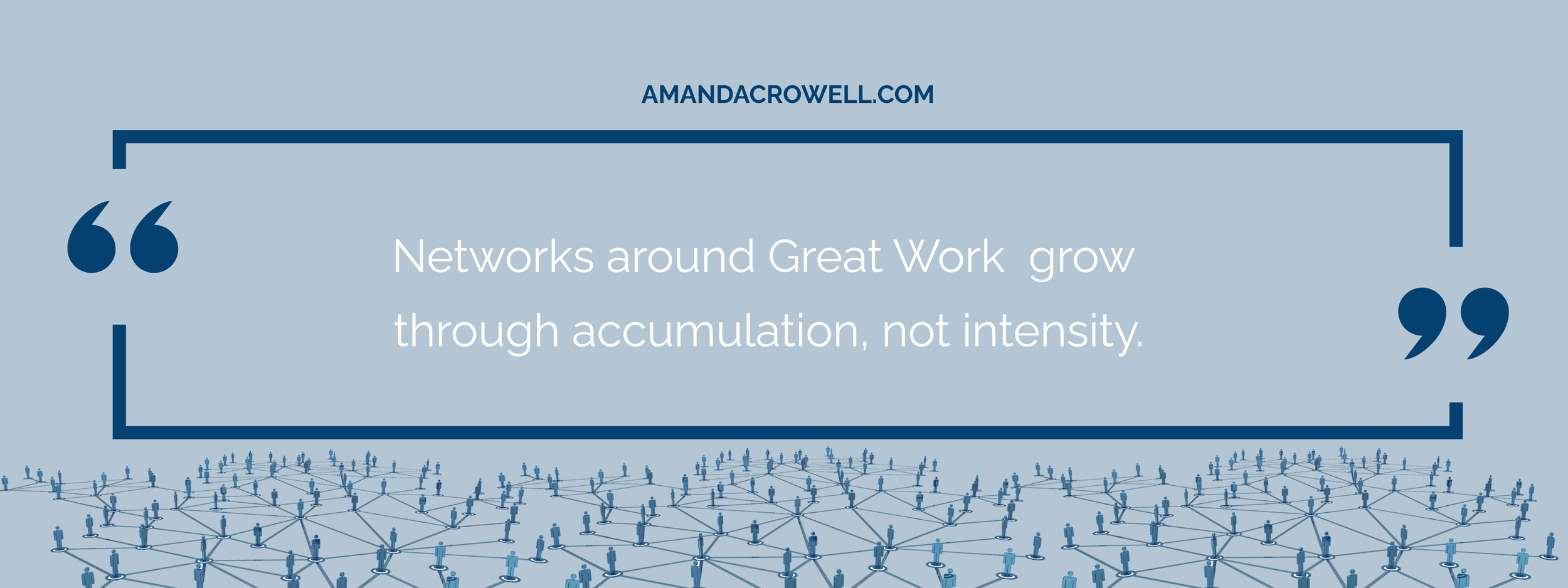
A small group of people who are genuinely oriented to your work can matter more than a large group who are only vaguely aware of it. Recognition accumulates person by person, across time.
This is where many people doing Great Work underestimate what they already have. They are so focused on how low their numbers look that they miss the fact that a handful of people who truly understand their work is a good thing. No, a great thing!
It is the beginning of a well-functioning system.
Those people talk. They connect dots. They mention your work when something relevant comes up. They carry it into rooms you are not in.
Movement looks like this: Someone remembers your work because they have encountered it before and they know exactly when it belongs.
That’s not noise; it’s signal.
What changes when you stop forcing
When you stop trying to force movement, attention shifts. You can stop evaluating every interaction by whether it produced a result. You can stop treating every post, email, or conversation as a test.
Instead, you begin to notice whether familiarity is building.
Do people recognize your work when they see it again?
Do they understand it more easily over time?
Do they know where to go if they want to deepen their understanding?
These signals are far more reliable.
In a living ecosystem, growth shows up as stability before it shows up as scale. The work holds its shape. The right people stay. The connections that matter strengthen.
Each clear articulation of your work adds another layer of familiarity. Each steady appearance gives people another reference point.
Over time, the system does what systems do.
Learn to see your network this way
Seeing your network as an ecosystem does not mean doing less. It means doing what works for the kind of work you are building.
If your work depends on trust, context, and understanding, then the way it moves has to honor those conditions.
This is the other way to approach visibility. One grounded in how people pay attention, how ideas spread, and how relationships change over time.
If you want help seeing your own network through this lens, my monthly free classes explore how ideas move through real networks, how familiarity builds, and how to tell whether your system supports the work you want to do more of.
I would love for you to join us!
