
The Strength of Weak Ties, Reframed: How Great Work Actually Spreads
If you have spent any time around social network research, you have likely encountered the idea that weak ties matter.
Acquaintances connect us to information we would not otherwise encounter. Loose connections bridge between social worlds. Opportunity tends to travel across distance rather than closeness.
This insight is well established. It is also where most explanations stop.
When people try to apply this idea in real life, the guidance often feels thin. The behavior it seems to imply feels off. Thoughtful people sense a mismatch between what the research points to and how they want to move through relationships.
That tension points to a missing distinction.
A simple three-tier way to understand networks
Here is the frame that makes the research usable.
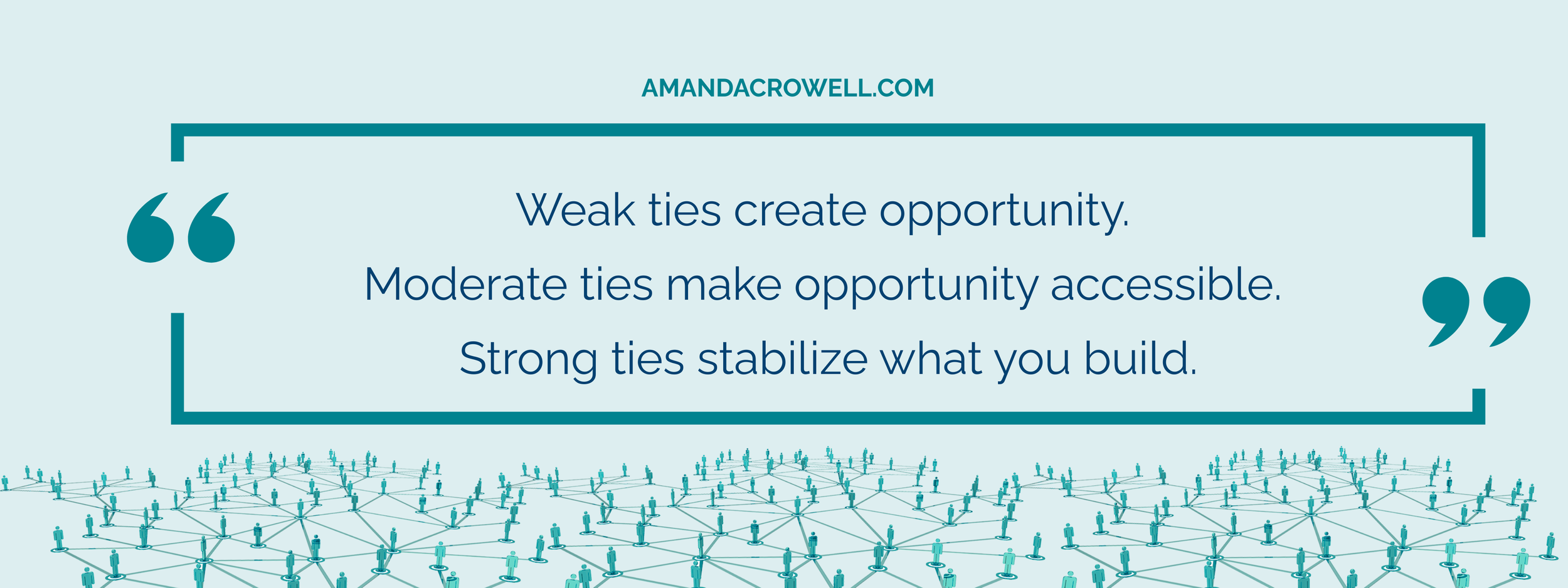
Weak ties create opportunities.
They connect you to people, ideas, and opportunities beyond your immediate circle.Moderate ties make opportunities accessible.
They recognize your name, understand your work well enough to place it, and are still far enough away to connect you into rooms you do not already occupy.Strong ties stabilize what you build.
They offer depth, collaboration, support, and continuity over time.
All three matter. Each does different work.
Much of the literature emphasizes weak ties because they explain where opportunity exists. That emphasis is sound. Where people struggle is in understanding how opportunity becomes accessible in a way that respects context, timing, and relationship.
That work happens in the middle.
Why weak ties alone don’t help people act
Here’s where things start to break down for people.
They understand the idea that opportunity often comes through weak ties. They’ve seen it happen. They believe it, at least in theory.
What they don’t see is how they’re supposed to move there.
Weak ties point to where opportunity tends to exist. They don’t say what makes an action appropriate inside a relationship that hasn’t been warmed up yet.
So people fill in the gap themselves.
If opportunity lives in weak ties, it starts to feel like you’re supposed to do something there. Reach out. Make a move. Ask.
Nothing in the research says that directly. The conclusion emerges through omission.
This helps explain the proliferation of cold pitches. People experience this every day in their inboxes and DMs. They recognize the move immediately, and most dislike being on the receiving end.
Faced with the same implication, many thoughtful people choose not to participate. They do not want to become someone who reaches out without context, familiarity, or permission. Rather than override that instinct, they disengage.
Weak ties aren’t the problem; the missing middle is.
Moderate ties are where opportunity becomes accessible
This is where the missing middle matters.
Moderate ties are weak ties that have been warmed. Not through intensity. Through familiarity with your work.
These are people who recognize your name and have encountered your ideas more than once. They understand your work well enough to describe it without straining. They can place it in context.
They aren’t close to you, and they don’t need to be. What matters is that they’re oriented to the work itself.
That orientation changes what becomes available.
When someone understands your work, they can recognize where it fits. They know when to pass it along, when to mention it, when to invite you into a conversation where it belongs.
This is how Great Work spreads.
A weak tie might pass along an opportunity by chance. A moderate tie recognizes relevance. They see the connection between what you do and what’s needed.
This is why so many meaningful openings come from people you haven’t spoken to recently, but who have been paying attention over time.
In research terms, this often shows up as the value of moderately weak ties. Strong ties tend to circulate what you already know. Very weak ties often lack context. The middle carries both reach and understanding.
You don’t need the terminology to use the insight.
What matters is this: Great Work rarely travels from the coldest edge of a network. It moves through people who understand it well enough to carry it forward.
That’s the work moderate ties do.
Why this is where people freeze
It’s one thing to understand that networks matter. It’s another thing to know what to do with that understanding.
Most people already know that care develops over time. They know ideas need to be encountered more than once. They know familiarity matters.
When weak ties are presented as the source of opportunity, it feels like that nurturing gets edited out of the picture. What’s left feels like a single move: reach out to strangers, explain your Great Work, ask for their assistance.
People feel a clear “no” to that move. They feel it when it lands in their inbox. And they feel it again when they imagine sending it themselves.
So they stop. This freeze isn’t procrastination, laziness, or a mindset issue. It’s a refusal to violate how relationships actually develop.
And listen, cold outreach has its place, and there is a way to do it that isn’t terrible. It just isn’t the lesson people are meant to take from social network theory.
What this changes about visibility
Once the middle is visible, visibility starts to make sense again.
It stops being about exposure. It starts being about understanding.
People don’t come to care about work because they’re asked to. They care because they encounter it, understand it, and see where it fits. Familiarity gives them a way to place it. Context gives them a reason to remember it.
This is why steady presence matters more than big pushes. Not because consistency is a virtue, but because recognition develops through repeated contact.
When moderate ties are doing their work, visibility doesn’t require performance. You don’t need to announce yourself repeatedly or justify your relevance. You need to make your work understandable and available over time.
That shift removes a lot of pressure.
You’re no longer trying to extract attention from people who aren’t oriented yet. You’re supporting the conditions that allow the right people to recognize your work when it’s relevant.
This is how Great Work travels without being forced.
The long view
Networks don’t work on demand. They work through accumulation.
Each time someone encounters your work and understands it, a reference point forms. Each time they see it again, that reference strengthens. Over time, familiarity turns into recognition.
Some ties stay weak. Some become moderate. A few deepen further. Each plays a role.
Strong ties will sustain you and your work. Weak ties will continue to connect you into new spaces. Moderate ties will make your Great Work accessible in moments when it fits.
This process takes time. That’s not a drawback. It’s what keeps the work grounded in real relationships rather than forced attention.
When you understand how this works, you can stop trying to shortcut care. You can focus on clarity, continuity, and presence. You can let people come to your work at a pace that makes sense.
That’s how Great Work spreads.
If you’re thinking about how your work travels, who it reaches, and what kind of impact you want to make, our Network Effect Lab is an invitation to go deeper. Check it out today.
-
Weak ties are people you know loosely rather than closely. They might be acquaintances, former colleagues, or people you’ve interacted with occasionally over time. Social network research highlights weak ties because they connect us to information and opportunities outside our immediate circles. They bridge different social worlds. What weak ties explain well is where opportunity tends to exist. They don’t explain how opportunity becomes appropriate or accessible inside a real relationship. That missing piece is where many people struggle to apply the research in humane, workable ways.
-
Moderate ties are weak ties that have been warmed through familiarity with your work. These are people who recognize your name, understand what you do well enough to place it, and have encountered your ideas more than once. They aren’t close friends, but they aren’t strangers either. This middle layer matters because it combines reach with context. Moderate ties are often the ones who can recognize when your work fits a situation and pass it along deliberately. This is where Great Work most reliably becomes accessible.
-
Cold outreach isn’t inherently wrong (and it can be done well!), but it’s often treated as the takeaway from social network theory when it shouldn’t be. Many people feel a strong internal resistance to reaching out without context, familiarity, or invitation. That resistance isn’t fear or procrastination. It’s an unwillingness to act in ways that contradict how care and understanding actually develop. When nurturing and familiarity are left out of the picture, the remaining options feel misaligned. Most thoughtful people respond by disengaging rather than forcing themselves to act against their relational instincts.
-
Great Work spreads through recognition, not persuasion. People come to care about work because they encounter it more than once, understand what it’s for, and can recognize when it becomes relevant. This happens over time, through moderate ties who are oriented to the work itself. Visibility, in this sense, is less about exposure and more about familiarity. When people understand your work well enough to recognize where it fits, they can carry it forward naturally. This is a slower process, but it’s also more stable and more humane.
