
On competing commitments, defensive failure, and the exhausting business of getting in our own way.
Recently, I was chatting with a woman at my local library who told me about a wonderful idea she had.
We'll call her Leanne, since she preferred that I not use her real name.
Leanne had noticed that many of the older patrons who visited the library had fascinating stories to tell. She wanted to start an oral history project to preserve those stories, inspired by an experience she'd had interviewing her grandfather through StoryCorps.
It was a terrific idea. Exactly the kind of thing libraries are uniquely positioned to do. And Leanne was excited about it!
There was just one problem.
She was having an absolutely terrible time getting herself to do it.
Eventually, she gathered the courage to mention the idea to her director. Her director was interested and asked her to put together a proposal with a preliminary budget.
Leanne wrote the proposal.
And then it took her TWO WEEKS to hand it in.
Not two weeks to write it. Two weeks to physically hand over a document she'd already finished, to a director who had specifically asked for it.
What on earth was going on?
When you want to do something AND don't want to do it
One of the most fascinating things about Great Work, the work that matters most to us, is that it makes us vulnerable.
Think about it.
When you pursue your Great Work, you're bringing your unique perspective into the world. But what if people misunderstand you?
You're pushing yourself to grow and learn. But what if you fail?
You're connecting with people who can support your work. But what if they reject you?
You're trying to make a meaningful contribution. But what if nobody cares?
These worries are baked into the experience of doing Great Work. The more something matters to us, the more emotionally significant these possibilities become.
So we find ourselves in a very peculiar situation.
We desperately want to do our Great Work.
And we desperately want to avoid the uncomfortable experiences that might come with doing it.
I WANT TO.
I DON'T WANT TO.
Psychologists call these competing commitments.
And navigating competing commitments can be EXHAUSTING.
Let's return to Leanne, standing outside her director's office.
She's got the proposal in her hand. She's ready to go.
Okay. I'm going to give it to her.
Oh, she looks busy. I shouldn't interrupt.
But she asked for it!
Right. I'll just knock.
Although, I never did double-check the cost of those microphones.
Maybe I should do that first.
And back to her desk she goes.
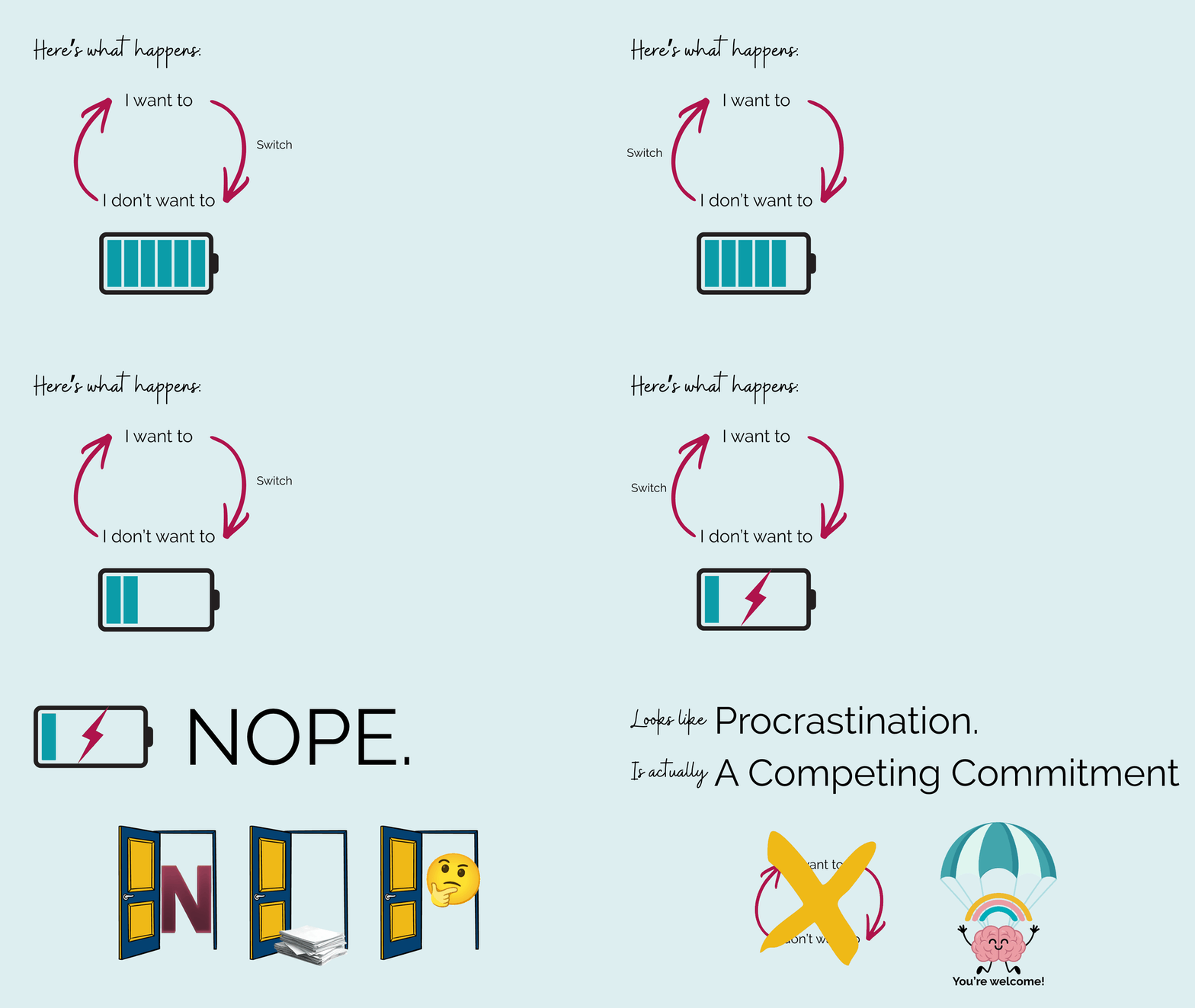
Now imagine doing this for two weeks.
All that back-and-forth takes effort. Every time Leanne works up the courage to approach her director, reconsiders, and convinces herself to try again later, she's using mental energy without getting any closer to her goal.
Eventually, retreating to the safety of her desk starts to feel like an excellent idea.
And here's the interesting thing: from the outside, this looks like procrastination.
But Leanne has plenty of motivation. She has a compelling vision. She even has a finished proposal!
Her problem is that she's simultaneously committed to moving forward and protecting herself from what moving forward might mean.
Welcome to defensive failure.
I call this defensive failure: the failure of doing nothing to protect ourselves from the possibility of failing at something that matters.
It can look like procrastination, perfectionism, overthinking, avoidance, delaying, or self-sabotage.
Sometimes it's obvious. You're scrolling through Instagram instead of writing your book.
Sometimes it's disguised as responsible behavior. You're spending your fourth weekend redesigning your website because you're just not quite ready to tell people about your business.
And sometimes, like Leanne, you've done almost everything required to make progress, but you can't quite bring yourself to take the final step.
Here's why defensive failure is such a problem.
When we're doing Great Work, failure is inevitable.
We try things we don't know how to do. We share ideas that aren't fully developed. We make mistakes. We discover gaps in our knowledge. We hear no.
And then, if we stay in the game, we learn. We improve. We make another attempt.
That's productive failure.
Productive failure is how we get better at doing our Great Work.
Defensive failure, on the other hand, keeps us safely out of the game.
And I find this absolutely fascinating: we can become so committed to avoiding the possibility of failure that we guarantee a different kind of failure instead.
The book doesn't get written. The business doesn't launch. The idea doesn't get shared.
All to avoid the possibility that those things might not go the way we hoped.
What a spectacularly frustrating arrangement.
So how do we get out of our own way?
The first thing I want you to do is get curious about your resistance.
The next time you notice yourself procrastinating, endlessly preparing, or avoiding something you genuinely want to do, ask yourself:
What am I trying to protect myself from experiencing?
Maybe you're worried about being misunderstood. Maybe you don't want someone to reject your idea. Maybe you don't want to discover that you're not as good at something as you hoped.
Whatever it is, see if you can recognize the competing commitment underneath your resistance.
Then think about how you might take a step into productive failure.
Can you share an imperfect version of your idea with someone you trust? Try something on a smaller scale? Ask for help? Give yourself permission to be a beginner?
One of the things I emphasized in my recent keynote for the Southeast Florida Library Network is that we can help each other move through resistance.
Libraries do this beautifully. They give people places to experiment, communities where they belong, and opportunities to try out new identities before they're entirely sure they fit.
We can create those conditions in our own lives, too.
Because here's what I believe:
The more people doing their Great Work, the better our world will be.
And that means we've got to find ways to move through our resistance, take the risks that matter, and do some good old-fashioned productive failing.
There's Great Work to be done!
Want to understand your own resistance?
I've put together a complete guide to resistance, competing commitments, and defensive failure, including ways to recognize the patterns that keep us stuck and get back to doing our Great Work.
AI Transparency: This article was adapted from a live keynote I delivered for the Southeast Florida Library Network in October 2026, with the assistance of generative AI. The ideas, stories, and psychological framework are my own.
